Archive for Awc

Fire, not water

“Then they will deliver you up to tribulation, and put you to death; and you will be hated by all nations for my name’s sake. And then many will fall away, and betray one another, and hate one another. And many false prophets will arise and lead many astray. And because wickedness is multiplied, most men’s love will grow cold….”    Matthew 24: 9-12


One of the great blessings of my youth was the capacity to be genuinely puzzled by bad behavior. I knew good people made mistakes and sometimes told lies and such, but I really didn’t understand calculated wrong-doing. Evil was a mystery. Why would you do that? That would mess everything up.

I get it now, and alas, am much less often surprised by people who fall away, and betray and hate one another. I am reminded of Nathan Englander’s story about playing the Righteous Gentile game where Jews wonder, if the Holocaust came again, who would hide them and who would turn them in. In my house we call this game “Who can you count on in a firefight?”

Perhaps my youthful naïveté was in part a confusion of evil and weakness. The former preys on, in fact counts on, the latter. And when we feel the heat of real danger in our lives, when wickedness is multiplied, that’s when we learn what we, and our faith, are made of. But I don’t think it’s just strength that’s needed, it’s love.

It was my family’s love that shielded me from the twisted logic of hatred and allowed me to experience not merely moral outrage, but bewilderment. And in the reality of God’s love, God who Is Love, other systems for calculating the costs and benefits of our actions, however logical they appear in the moment, are absurd. I try to hang onto that in a world where fear makes most men’s love grow cold.

People say you fight fire with fire. That adage reminds me of another: Many waters cannot quench love, neither can floods drown it.

 

322px-Fire Wikipedia awesomoman


Twelve gates to the city

Then came one of the seven angels who had the seven bowls full of the seven last plagues, and spoke to me, saying, “Come, I will show you the Bride, the wife of the Lamb.” And in the Spirit he carried me away to a great, high mountain, and showed me the holy city Jerusalem coming down out of heaven from God, having the glory of God, its radiance like a most rare jewel, like a jasper, clear as crystal. It had a great, high wall, with twelve gates, and at the gates twelve angels, and on the gates the names of the twelve tribes of the sons of Israel were inscribed; on the east three gates, on the north three gates, on the south three gates, and on the west three gates. 

Revelation 21: 9-13


I first learned about Clara Ward from Horace Clarence Boyer, who came to my church one Trinity Sunday for a workshop and concert. Ward composed what is probably my favorite of all gospel hymns, “How I Got Over.”


Saints, known and unknown

Today is the Solemnity of All Saints. While searching for a bit of the history of this day, I read that the celebration was instituted “to honor all the saints, known and unknown.”

Saints, known and unknown. A humbling reminder that sainthood is not conferred by the Church, but only recognized. Like the lamed vavniks of Jewish legend and the angels we entertain, there are saints we encounter unawares, but through whom the kingdom of God comes near.

May we someday know one another, even as we are known, and in that blest communion join to sing.

Alleluia!


St. Jude, patron of lost causes

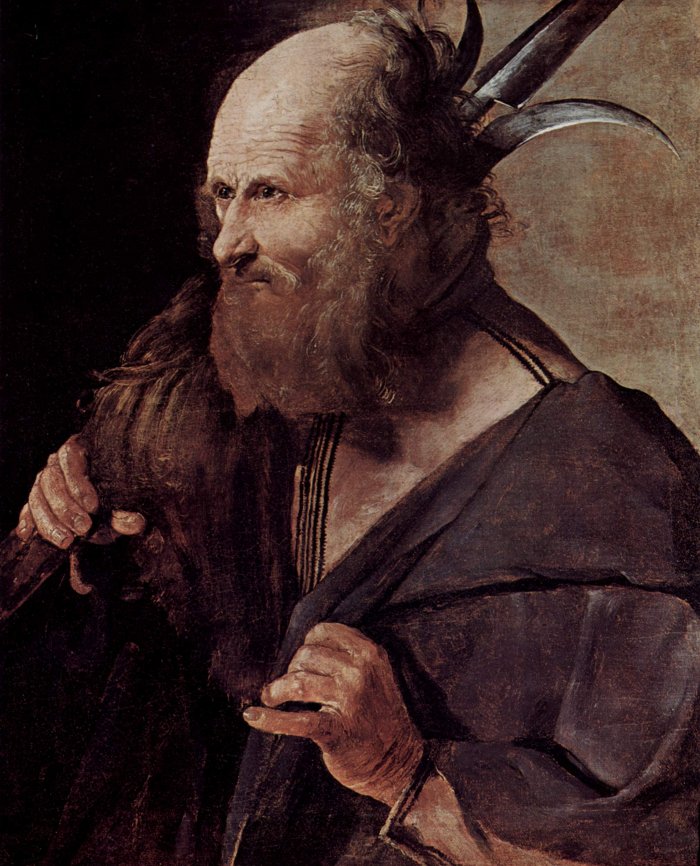
St. Jude Thaddeus Georges de La Tour 1650

St. Jude Thaddeus, Georges de La Tour, 1650


Today is the feast day of St. Jude, the patron saint of lost causes, the Chicago police department and many hospitals. I first learned of St. Jude watching The Untouchables, a movie about Eliot Ness’ pursuit of Al Capone during Prohibition. In that movie, the team is enjoying supper after a successful raid when Ness sees Malone, a long-time beat cop, holding a saint’s medal on a chain.

“What is that?” he asks.

Malone responds with surprise, “What is that?”

“Yes, what is it?”

“God, I’m with the heathen.” Showing Ness the medal, Malone explains, “That is my call box key, and that is St. Jude.”

Stone, a young Italian on the team says, “Santo Jude. He’s the patron saint of the lost causes.”

“And policemen,” says Malone.

If you grew up in the Protestant tradition as I did (and are thus among Malone’s heathen), the origin stories of heavenly advocates can be startling. They certainly represent some of humanity’s most creative attempts to explain God’s work in the world, and to honor the holy people among us.

So why did St. Jude get saddled with the lost causes, and how did those causes come to be their own category among all the professions and diseases that are identified with other saints?

Wikipedia gives us an amusing explanation that I’ve found repeated on several other web sites. I have no idea how this tale came to be, or indeed if it is a traditional or modern fabrication. Still, it’s a great story, and with that caveat, I’ll share it:

St. Jude is known as the patron saint of lost causes amongst Roman Catholics. This is due to the tradition that, because his name was similar to the traitor Judas Iscariot, few, if any faithful Christians prayed for his intervention, out of the mistaken belief that they would be praying to Judas Iscariot. As a result, St. Jude was little used, and so became eager to assist any who asked him, to the point of intervening in the most dire of circumstances. The Church also wanted to encourage veneration of this “forgotten” disciple. Therefore, the Church maintained that St. Jude would intervene in any lost cause to prove his saintliness and zeal for Christ, and thus St. Jude became the patron of lost causes.

I laugh to think of St. Jude with nothing to do in heaven–no prayers coming in–eagerly taking on dire problems that no other saints would touch. Surely this is one of those instances of imagination run wild. Nevertheless, I do think that recognizing the place of lost causes in the life of the Church and asking for a bit of help is good and appropriate. We’ll always have the poor. And human nature. There’s a lot in this world that could bring a body to despair.

So, as I think about St. Jude, I’m reminded of another movie where a character named Jefferson Smith says lost causes are the only ones worth fighting for; his advocate, Clarissa Saunders, says they’re taken up by fools with faith in something bigger. On this feast day, that sounds about right to me.

 …the message of the cross is foolishness to those who are perishing, but to us who are being saved it is the power of God. (1 Corinthians 1)


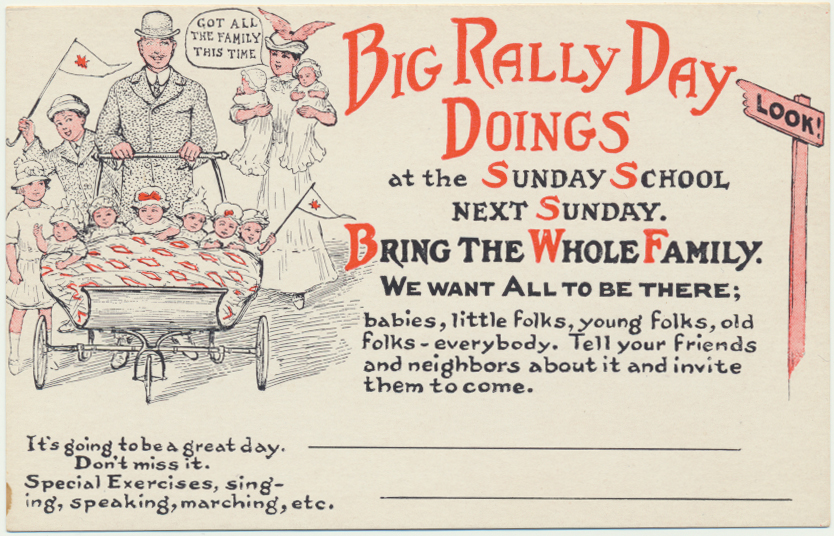
Rally Day Doings

Whole Family Rally Day


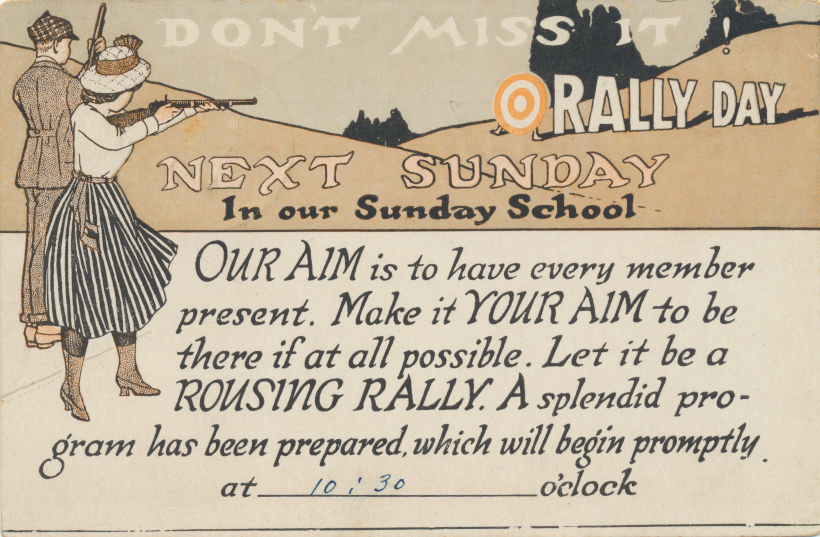
Dont miss it Rally Day


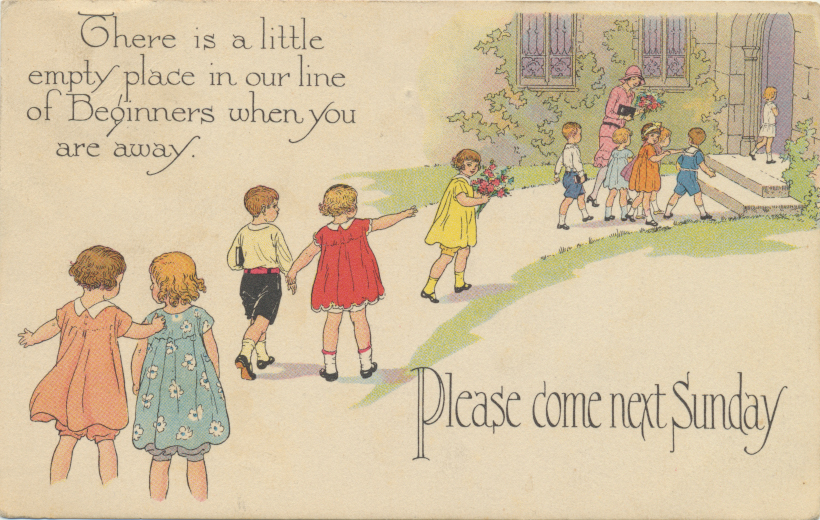
The last in my series of vintage postcards: Rally Day invitations from the early 1900s, when birth control was illegal, and apparently no one worried about putting guns on a Sunday school advertisement.

“Special Exercises, singing, speaking, marching, etc.” A Rousing Rally indeed!

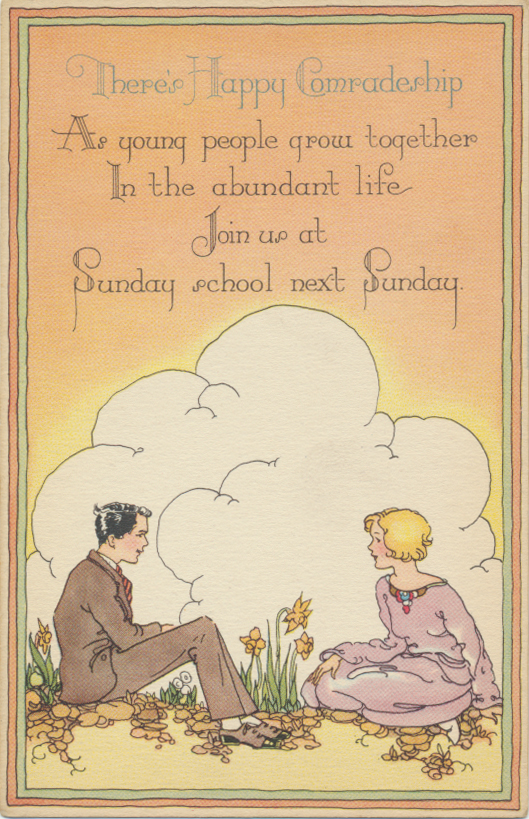
Happy Comradeship

Three more vintage postcards invite everyone to church: happy children, shy teens, and even those who fly in on Sunday mornings. (How convenient to have the runway so near the church!) Charming illustrations, full of light and affection.


Good landing place HiRes multi


Happy Commradeship2


Empty place 300ppi

Memo to the working girl

Working Girl 300ppi


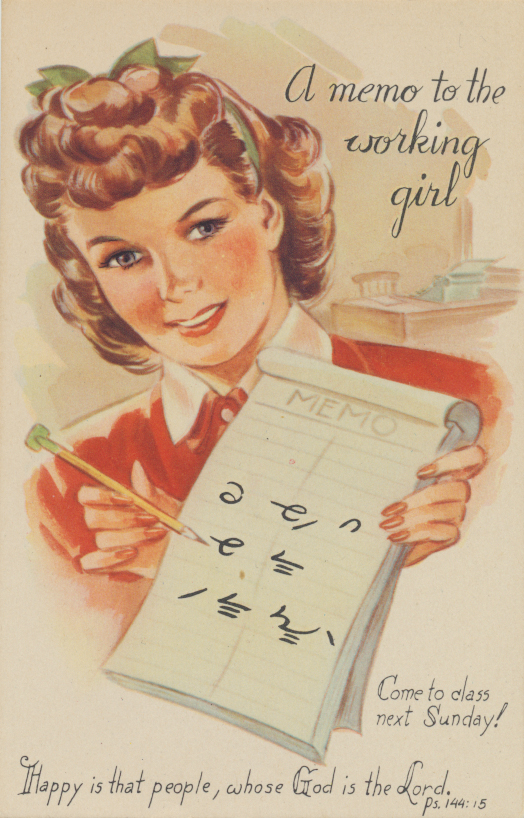
I had some fun this week looking through vintage postcards. Wish I could read the shorthand on this one! I also wish I knew who the artist was. The composition and the use of color are terrific. Just look at the way the space is layered on a diagonal from the memo pad all the way back to the desk and typewriter. It’s a great example of commercial art reaching out to a specific audience, and it shows the Church pushing to stay current.

The printed message on the back reads:

Dear___

Things seem not quite right when you are away. Hope to see you next Sunday. If there is any other reason that you cannot come, please let us hear from you.

Sincerely your friend

____


A little lectio

Deliver me, O Lord, by your hand 
from those whose portion in life is this world;

Whose bellies you fill with your treasure, 
who are well supplied with children
and leave their wealth to their little ones.

But at my vindication I shall see your face; 
when I awake, I shall be satisfied, beholding
your likeness.

Psalm 17: 14-16


These three verses spoke to me today. “Deliver me…from those whose portion in life is this world.”  It’s a striking description of the dynasties of wealth and power that control the earth and fill the news. It sums up their reach through time and the limits of that reach. And I love the way that vindication–satisfaction–comes on the other side of death. Are the wicked destroyed? Did they ever suffer? It doesn’t matter. The powerful have had their time, and we wake to behold the face of God.


A New Testament verse also struck me, and it felt like a sort of defiant acceptance of self–a sentiment with which I am familiar.  Perhaps, if you’ve ever felt out of step with the rest of humanity, you’ll know what I mean.


…by the grace of God I am what I am, and his grace toward me was not in vain.

I Corinthians 15: 10a

Thanksgiving

O my Lord, my Lord, I thank Thee
for that I am,
that I am alive,
that I am rational:
for nurture,
preservation,
governance:
for education,
citizenship,
religion:
for Thy gifts of grace,
nature,
estate:
for redemption,
regeneration,
instruction:
for calling,
recalling,
further calling manifold:
for forbearance,
longsuffering,
long longsuffering towards me,
many times,
many years,
until now:
for all good offices I have received,
good speed I have gotten:
for any good thing done:
for the use of things present,
thy promise
and my hope
touching the fruition of the good things to come:
for my parents honest and good,
teachers gentle,
benefactors always to be had in remembrance,
colleagues likeminded,
hearers attentive,
friends sincere,
retainers faithful:
for all who have stood me in good stead
by their writings,
their sermons,
conversations,
prayers,
examples,
rebukes,
wrongs:
for these things and all other,
which I wot of, which I wot not of,
open and secret,
things I remember, things I have forgotten withal,
things done to me after my will or yet against my will,
I confess to Thee and bless Thee and give thanks unto Thee,
and I will confess and bless and give thanks to Thee
all the days of my life.
What thanks can I render to God again
for all the benefits that He hath done unto me?


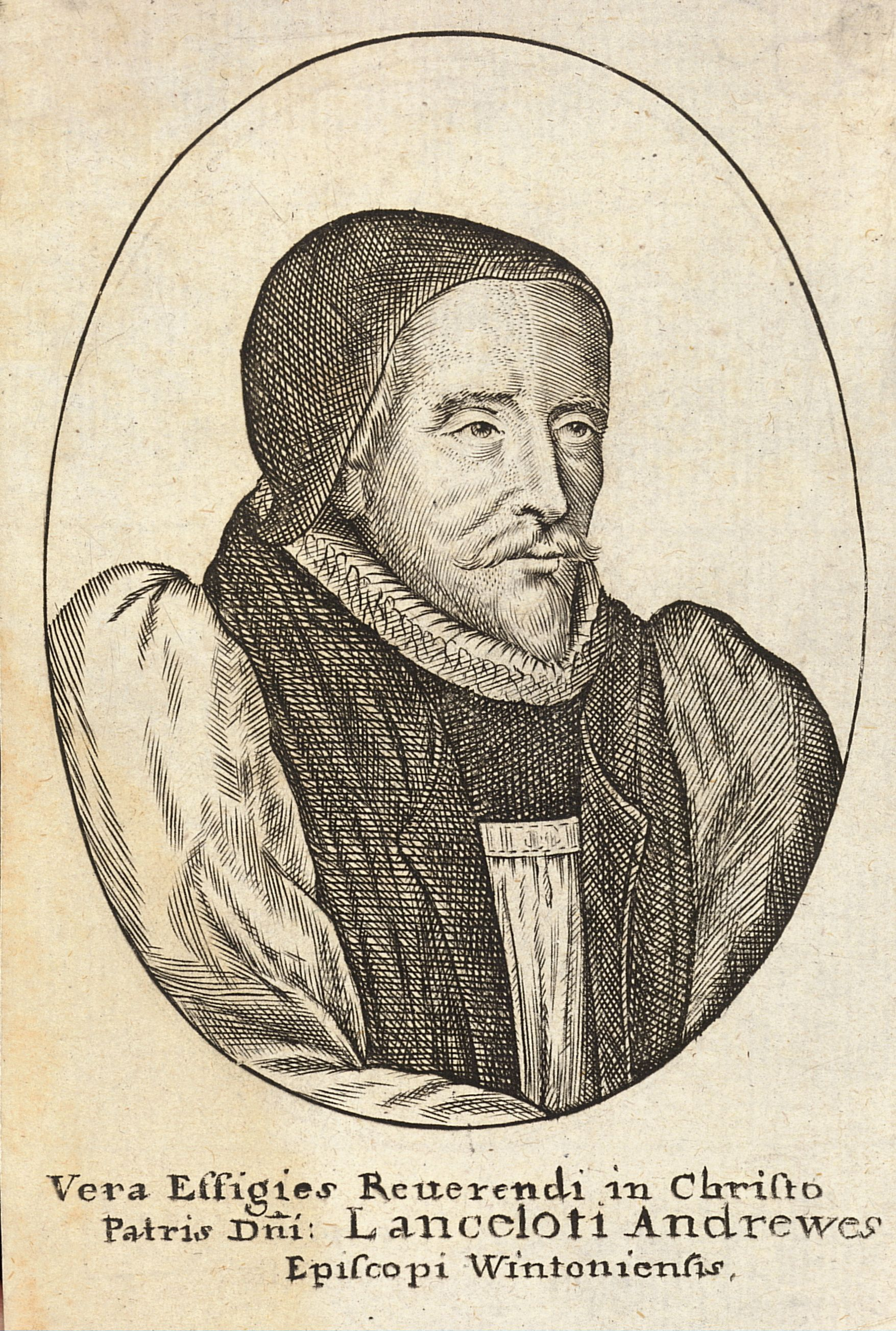
Lancelot Andrewes

via James Kiefer, The Lectionary

Lancelot Andrewes (State 1) by Wenceslaus Hollar

Lancelot Andrewes (State 1)
by Wenceslaus Hollar University of Toronto Wenceslaus Hollar Digital Collection via Wikimedia Commons

The movements of the soul – Christ among the doctors

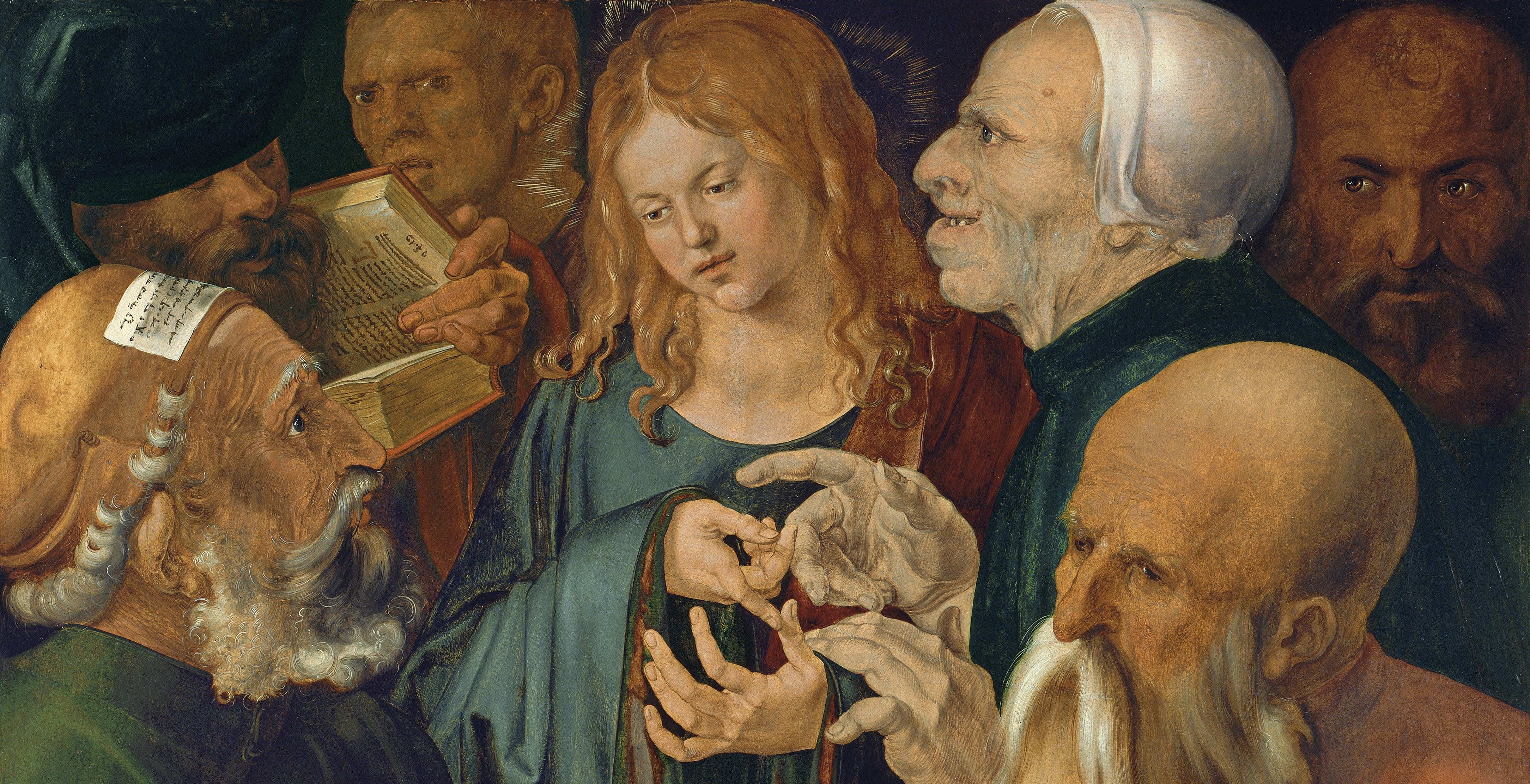
Albrecht_Dürer_-_Jesus_among_the_Doctors_-_Google_Art_Project

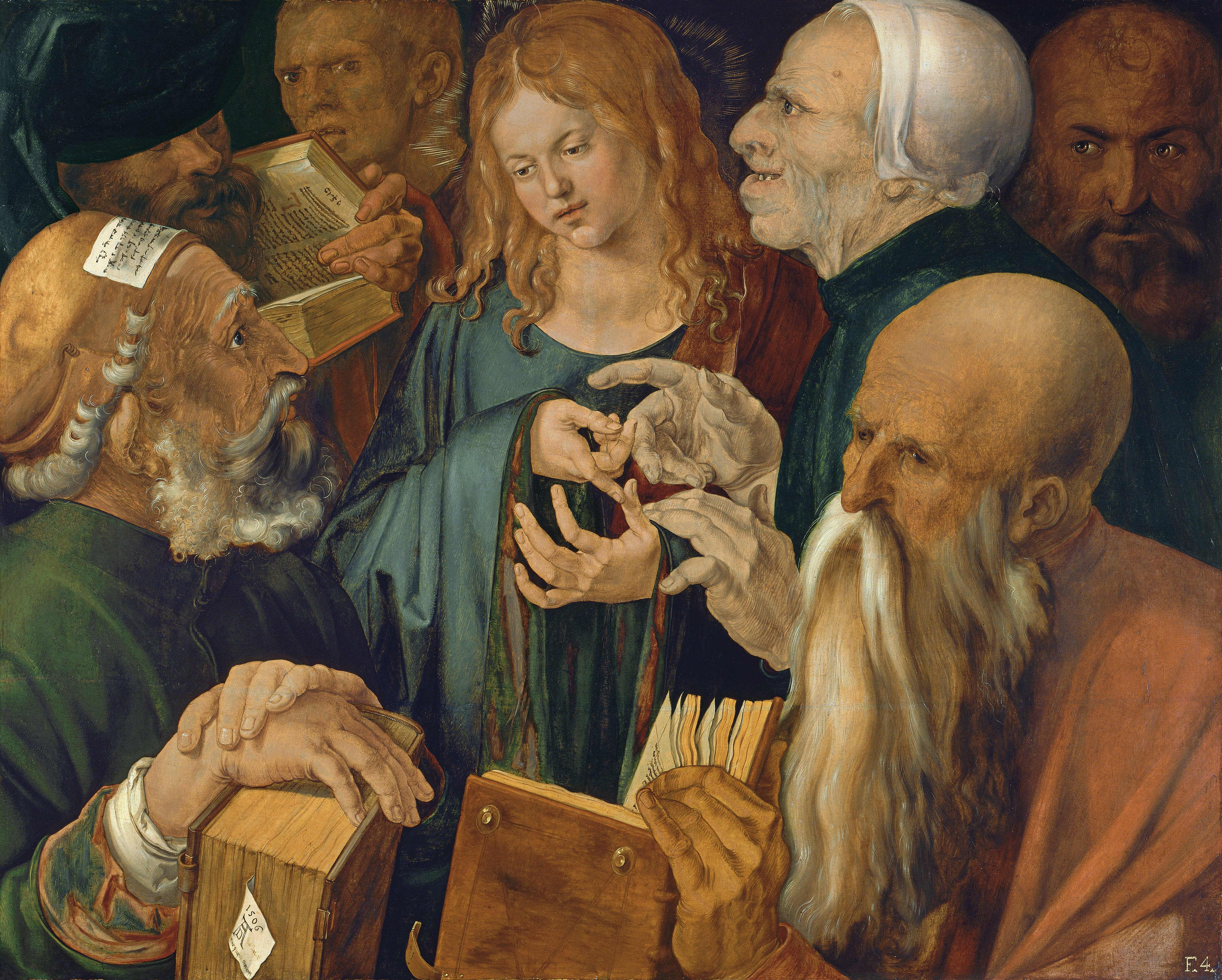
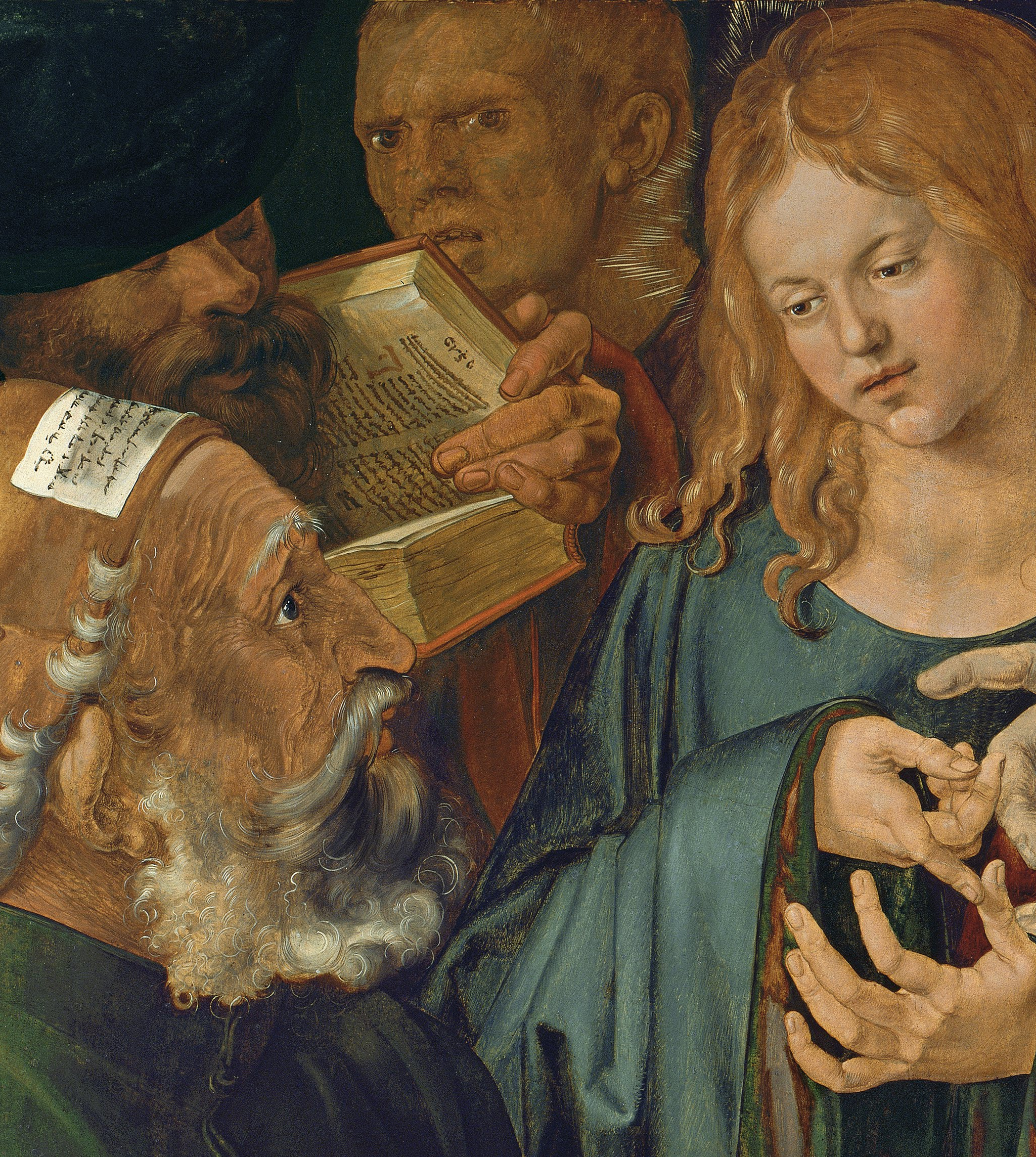
For years this painting–Albrecht Dürer’s Christ Among the Doctors–has seemed to me profoundly odd. It’s so crowded! All those heads and hands and books. Why on earth would the artist pack a painting that way? And truth to tell, it feels a bit uncomfortable and almost creepy. What is going on here? I couldn’t figure it out, but this summer I had the opportunity to see the painting in person, and standing in front it, I felt like I finally made some progress.

I knew the subject, of course: a young Jesus is in the temple among the teachers, “and all who heard him were amazed at his understanding and his answers.” (Luke 2: 41-52)  And I knew that gesture has long been an important carrier of meaning in art. “These movements of the soul are made known by movements of the body,” wrote the great Renaissance humanist Leon Battista Alberti. So I at least had some context for this painting that Dürer created in five days while working in Venice.

One of the things I like to do in a museum is take pictures of paintings with my cell phone. Not just pictures of the entire painting, but close ups of the interesting bits. Details. I find it helps me think. And after looking at Dürer’s painting with my camera, here’s how I see it.

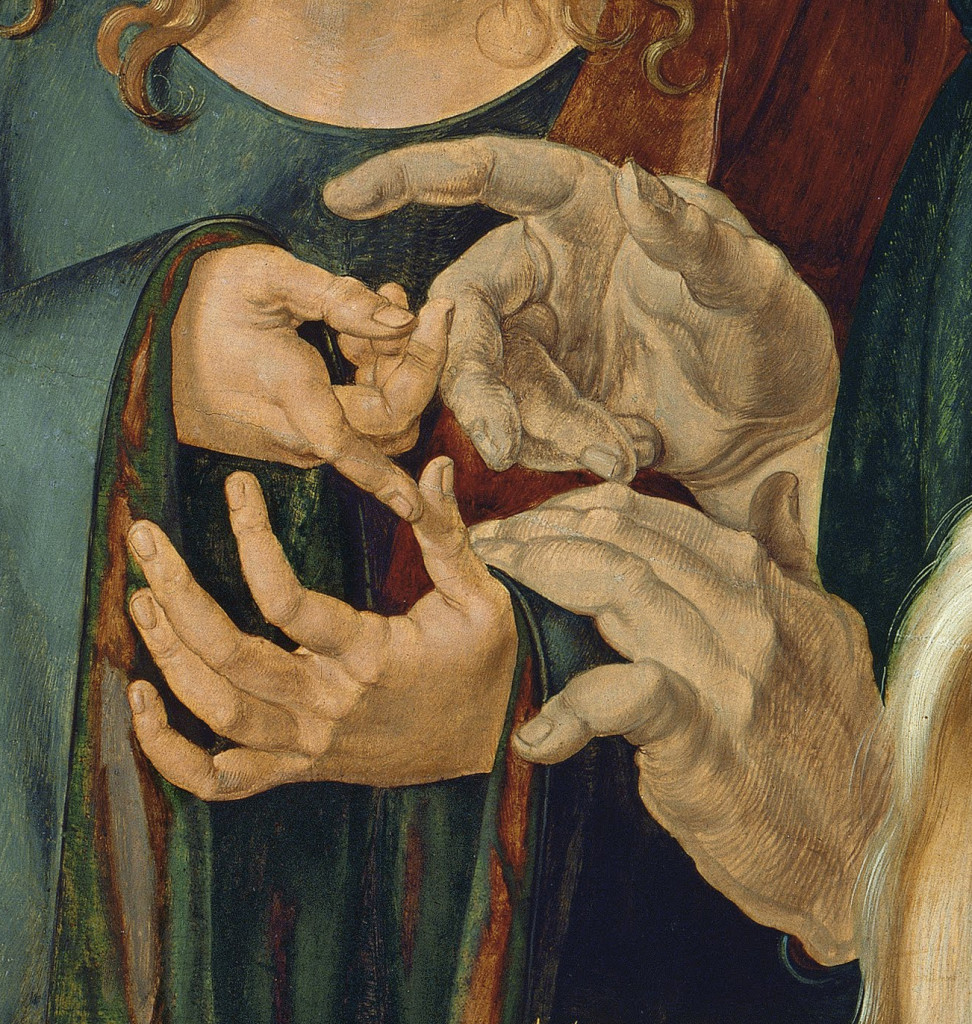
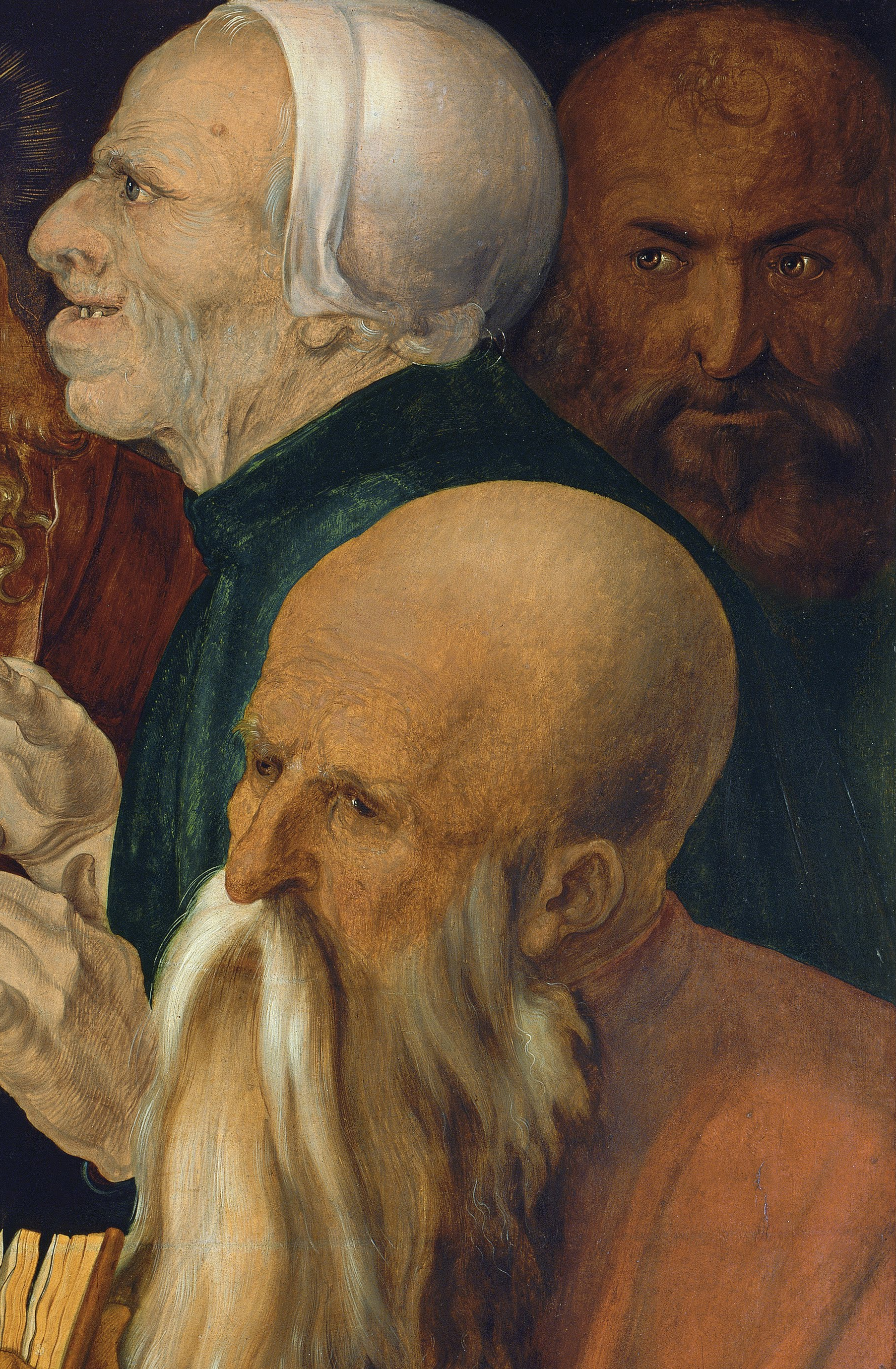
It’s the composition that reveals the story. At the center of the painting is a wheel of hands. Jesus’s young hands are making a point while the pale hands of the aged, blind teacher reach out to touch his arm and restrain him from speaking. That teacher–a doctor of the Law–is painted as a caricature, and caricature, like gesture, can be a quick way to convey a entire packet of meaning. We should understand this man’s blindness as both physical and spiritual. His hands are large and cold-looking as they try to overwhelm the boy Jesus’ hands.

Albrecht_Dürer_-_Jesus_among_the_Doctors hands center


Albrecht_Dürer_-_Jesus_among_the_Doctors Christ top


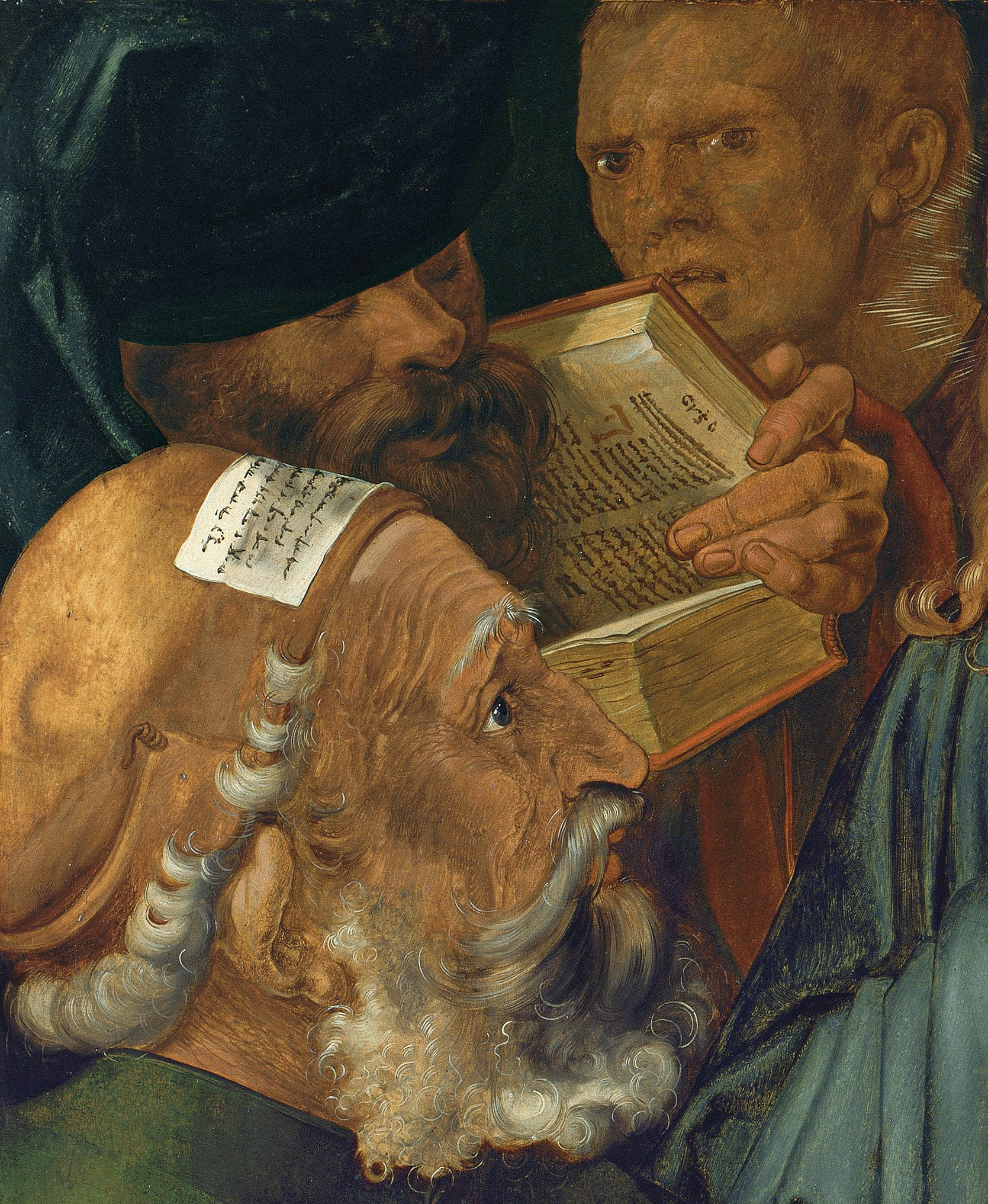
While none of the other faces are caricature, some of their expressions contribute to the viewer’s feeling of discomfort or danger. On either side of Jesus are two groups of three figures that mirror each other. Two of these figures are searching in books, arguing with Jesus about points of law. Two men catch our attention with their wild eyes: one looks at Jesus with suspicion; another looks out at the viewer with an expression of alarm.


Albrecht_Dürer_-_Jesus_among_the_Doctors upper left eyesAlbrecht_Dürer_-_Jesus_among_the_Doctors upper right


But in the midst of this swirl of confusion, mistrust, denial, and disputation, one of the teachers has stopped arguing. He looks at Jesus with what seems to me a world-weary hope, and Jesus, who has turned away from the blind doctor, meets his eyes with compassion.


Albrecht_Dürer_-_Jesus_among_the_Doctors Christ and Listener


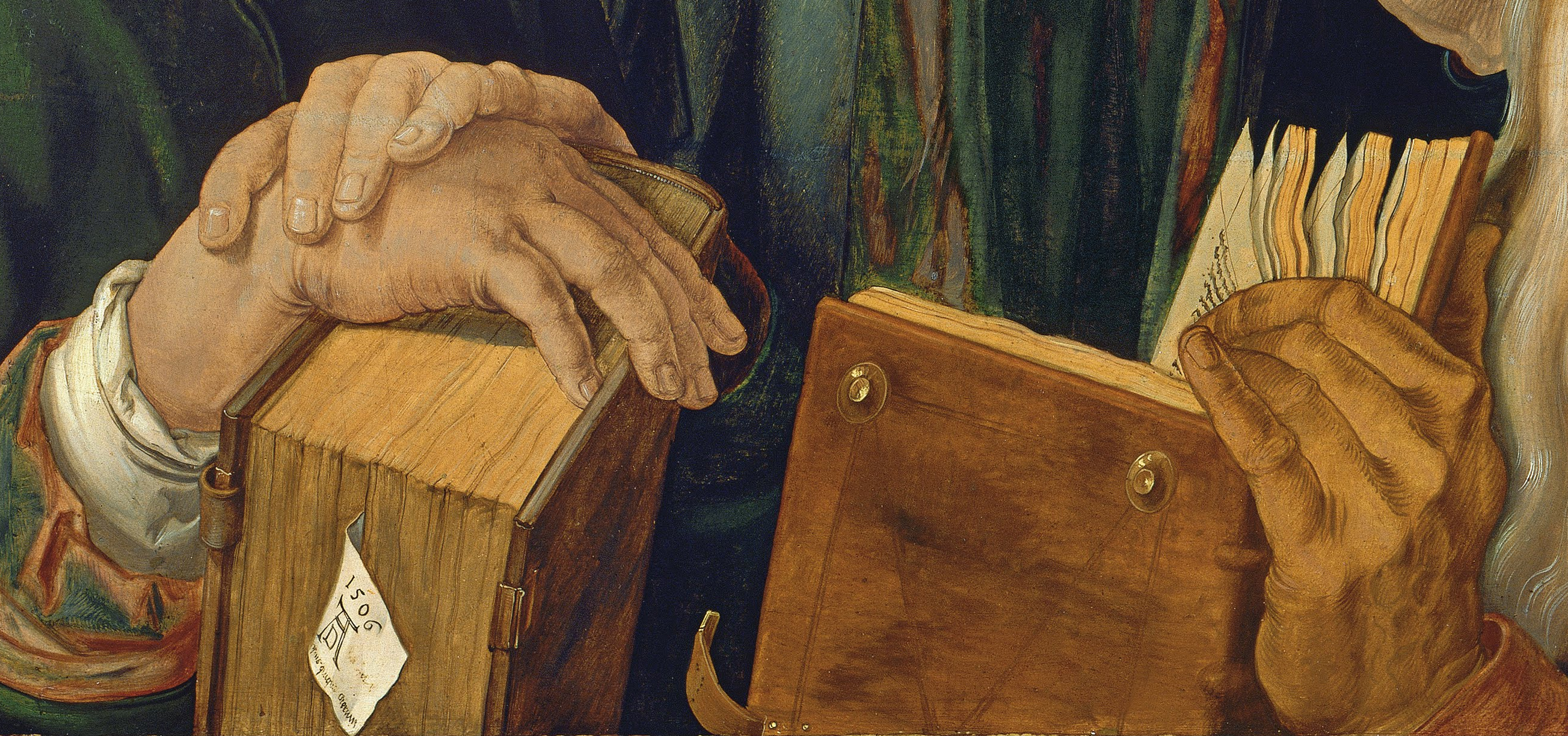
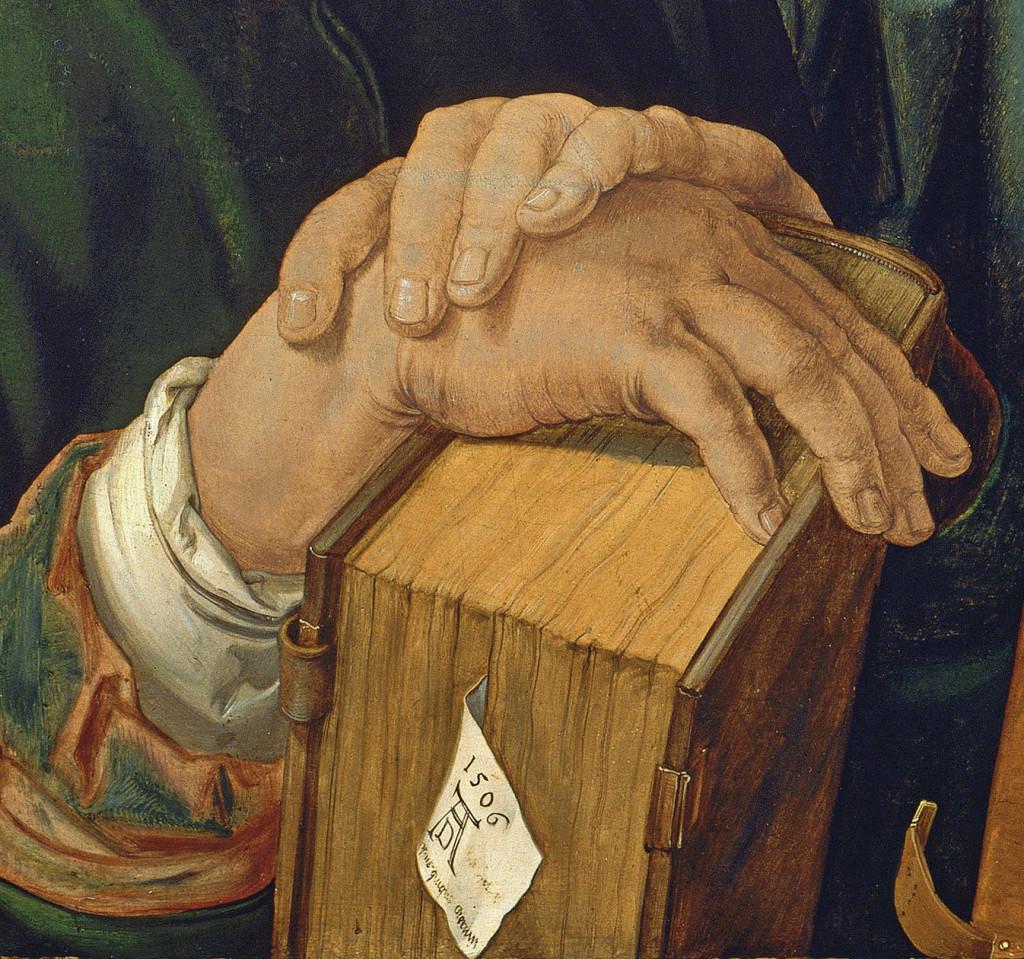
While all around people are moving their hands and rustling pages, this man has closed his book, and rests his hands on top of it as he listens attentively. In this stillness, he receives understanding.


Albrecht_Dürer_-_Jesus_among_the_Doctors books and hands


The story that began with a wheel of hands, ends with hands at rest. As he does throughout this work, Dürer first makes his point by showing us a pair of images–here two books.  And then, like a storybook’s closing “The End,” the artist completes the narrative and confirms its meaning his by placing his signature and date on a bit of paper slipped between the pages of the closed book.


Albrecht_Dürer_-_Jesus_among_the_Doctors listening hands


“The movements of the body reveal the movements of the soul,” says the artist. “Be still and know that I am God.”